Pump Sizing
Finds the power a pump puts into a liquid and the shaft power it needs to do so. Enter the flow rate, the total head and the pump efficiency, and pick a liquid to fill in its density [2]–[5]. Use it to make a first choice of pump and motor size for a transfer, cooling or supply system.
Equations
Ph = ρ·g·Q·H Pshaft = Ph/η
Ph is the hydraulic power, the energy given to the liquid each second [1]. ρ is the liquid density, g = 9.80665 m/s², Q the volumetric flow rate and H the total head. η is the pump efficiency as a fraction, so 75 % is entered as 0.75. Pshaft is the power the motor must deliver to the pump shaft.
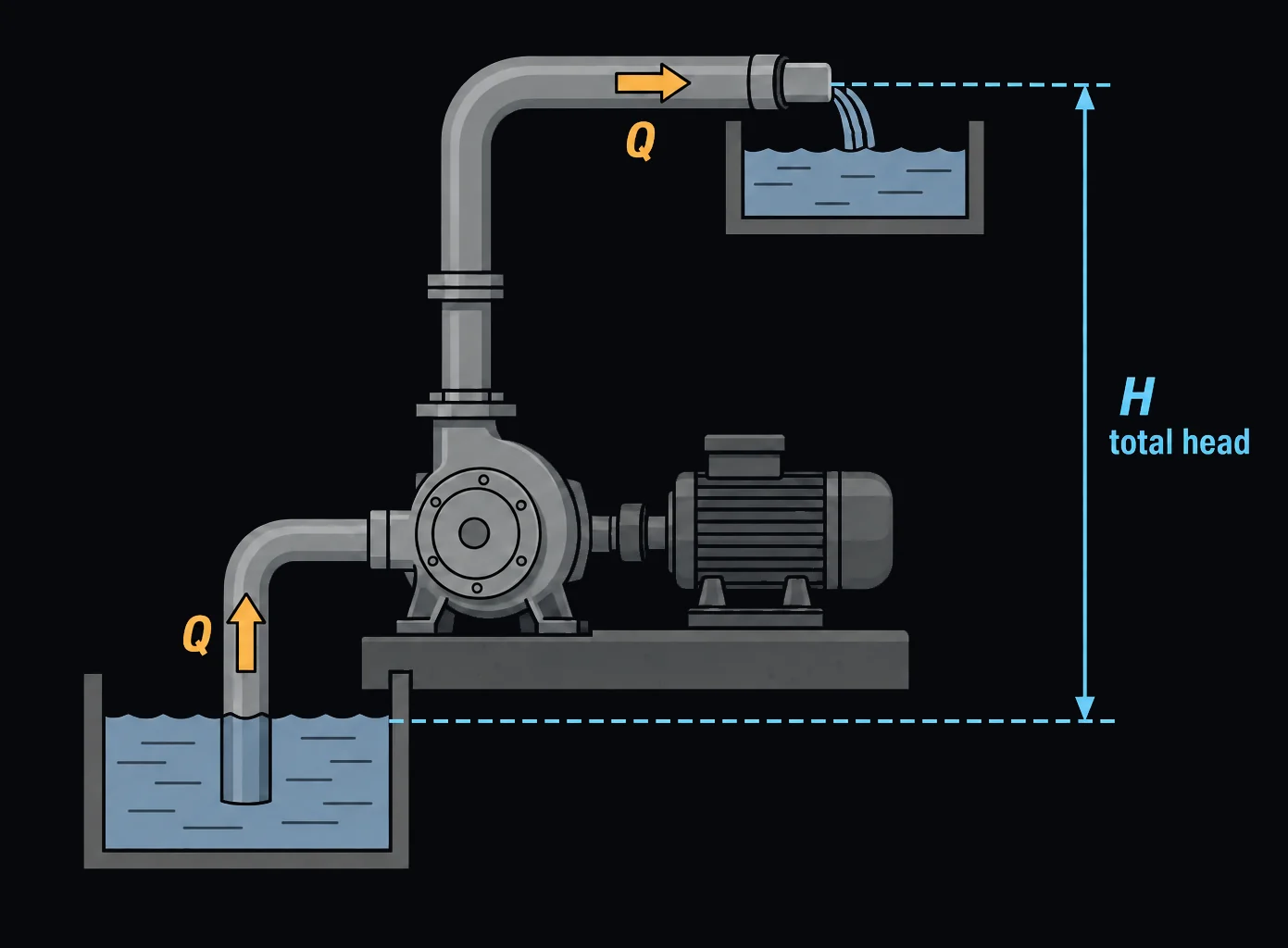
The total head is everything the pump must overcome, written as a height of the liquid being pumped. It is the rise from the suction surface to the discharge surface, plus the friction losses in the pipes, valves and fittings, plus any difference in pressure between the two tanks divided by ρg [1]. The Pipe Flow & Pressure Drop calculator gives the friction part for each straight run.
Limits and common mistakes
- Take the efficiency from the pump curve at the duty point. It falls well away from the best-efficiency point.
- Head is a height of the liquid, not a pressure. The same pressure is a greater head in a lighter liquid.
- The shaft power is not the motor rating. Add a margin, and allow for the motor’s own efficiency when finding the electrical input.
- Thick liquids such as oils lower a centrifugal pump’s efficiency and head. Use the maker’s correction.
- The page doesn’t check the suction side (NPSH) or the pump curve. Check them before buying the pump.
Worked example
A pump must move 12 L/s of water at 20 °C to a tank on a roof. The lift plus the pipe losses come to 35 m of head, and the chosen pump runs at 70 % efficiency at that point. Find the power it needs.
- Enter Flow Rate 12 L/s and Total Head 35 m.
- Choose Fluid Water, 20°C. The density fills in as 998.2 kg/m³.
- Enter Pump Efficiency 0.7 and press Solve. The Solution shows:
Hydraulic Power: 4.11138 kW
Required Shaft Power: 5.8734 kW
Check by hand. 998.2 × 9.807 × 0.012 × 35 = 4,111 W, and 4,111/0.70 = 5,873 W. A rule of thumb for water gives the same: hydraulic power in kW is about Q (L/s) × H (m)/102, or 12 × 35/102 = 4.1 kW. A 7.5 kW motor leaves a sensible margin over 5.9 kW.