Reynolds Number
Finds the Reynolds number of a flow and says whether it is laminar, transitional or turbulent. Enter the density, velocity, characteristic length and dynamic viscosity, or pick a fluid to fill in its properties [2]–[5]. A live Moody chart marks where the flow sits. Engineers use it before choosing a friction factor or a heat-transfer correlation, since most of them hold for one regime only.
Equations
Re = ρ·V·D/μ = V·D/ν ν = μ/ρ
Re is the ratio of inertia to viscous forces in the flow, and has no units [1]. ρ is the fluid density, V the mean velocity, D the characteristic length and μ the dynamic viscosity. ν is the kinematic viscosity. For flow in a round pipe, D is the inside diameter. For a duct of another shape, use the hydraulic diameter 4A/P, where A is the flow area and P the wetted perimeter [1].
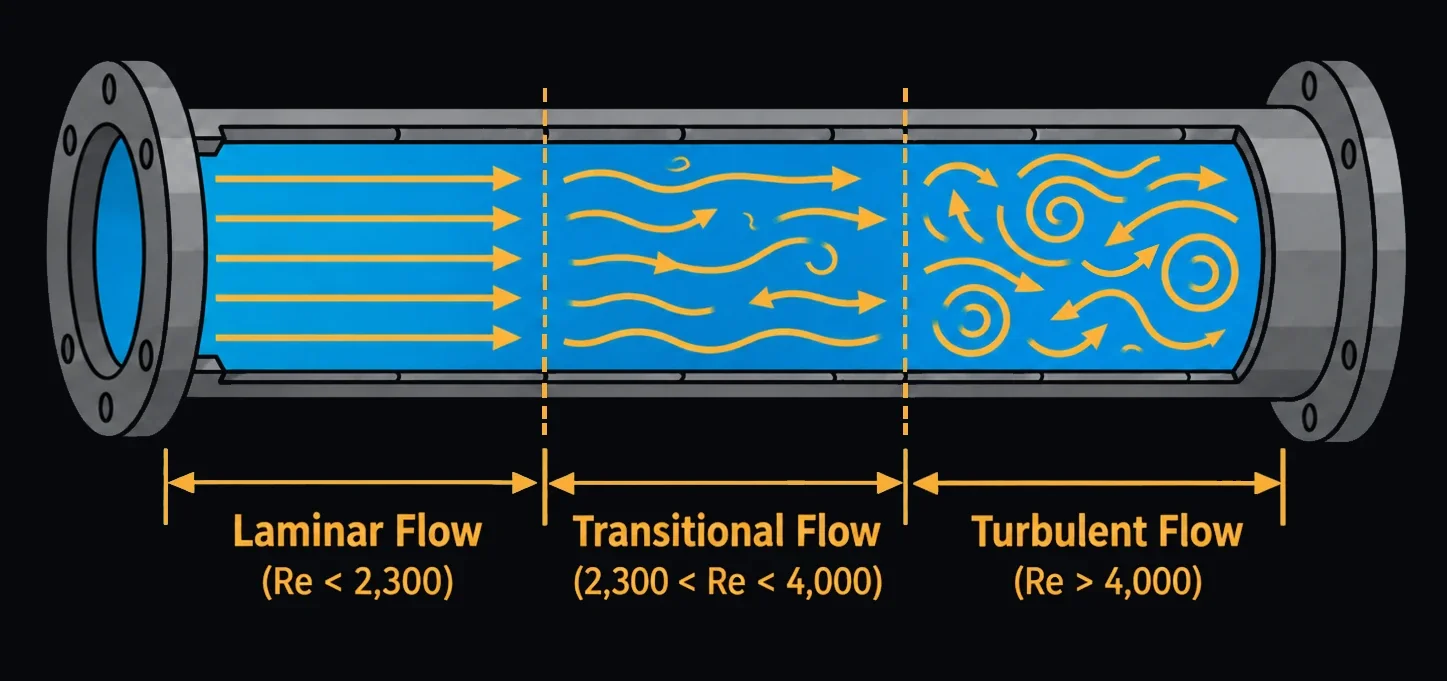
The regime limits are the usual ones for pipe flow [1]: laminar below Re = 2300, transitional from 2300 to 4000, and turbulent above 4000. In practice the change depends on how smooth the pipe is and how steady the flow is, so treat values near the limits as uncertain.
Limits and common mistakes
- Don’t mix the two viscosities. μ is in Pa·s (1 cP = 0.001 Pa·s); ν is in m²/s (1 cSt = 10−6 m²/s).
- Viscosity falls sharply as a liquid warms, oils most of all. Use properties at the flowing temperature.
- The regime limits are for internal pipe flow. Flow over a plate or around a cylinder changes regime at quite different values.
- This page has no roughness input, so the Moody chart marks the point on the smooth-pipe curve. Use the Pipe Flow & Pressure Drop calculator for a rough pipe.
Worked example
Light lubricating oil at about 40 °C flows at 1.5 m/s through a 25 mm bore lube line. Is the flow laminar?
- Choose Fluid Light lubricating oil (SAE 10, ~40°C). The density fills in as 870 kg/m³ and the viscosity as 0.05 Pa·s.
- Enter Velocity 1.5 m/s and Characteristic Length/Diameter 25 mm.
- Press Solve. The Solution shows:
Reynolds Number (Re): 652.5
Flow Regime: Laminar
Kinematic Viscosity (ν): 5.74713e-5 m²/s
Check by hand. ν = 0.05/870 = 5.747 × 10⁻⁵ m²/s, and Re = 1.5 × 0.025/(5.747 × 10−5) = 652.5, well into the laminar range, so f = 64/Re applies. Water at 20 °C in the same line would have Re ≈ 37,400 and be fully turbulent, because its viscosity is about 50 times lower.