Vibration Damping
Describes how a spring–mass–damper system settles after a disturbance. From the stiffness, mass and damping coefficient it gives the damping ratio, the critical damping, the undamped and damped natural frequencies and whether the system oscillates. A live plot below the Solution shows the free motion after the mass is pulled aside and let go. Designers use it to size dampers and shock absorbers and to judge how quickly a machine stops shaking.
Equations
ωn = √(k/m) cc = 2√(k·m) ζ = c/cc ωd = ωn√(1 − ζ²)
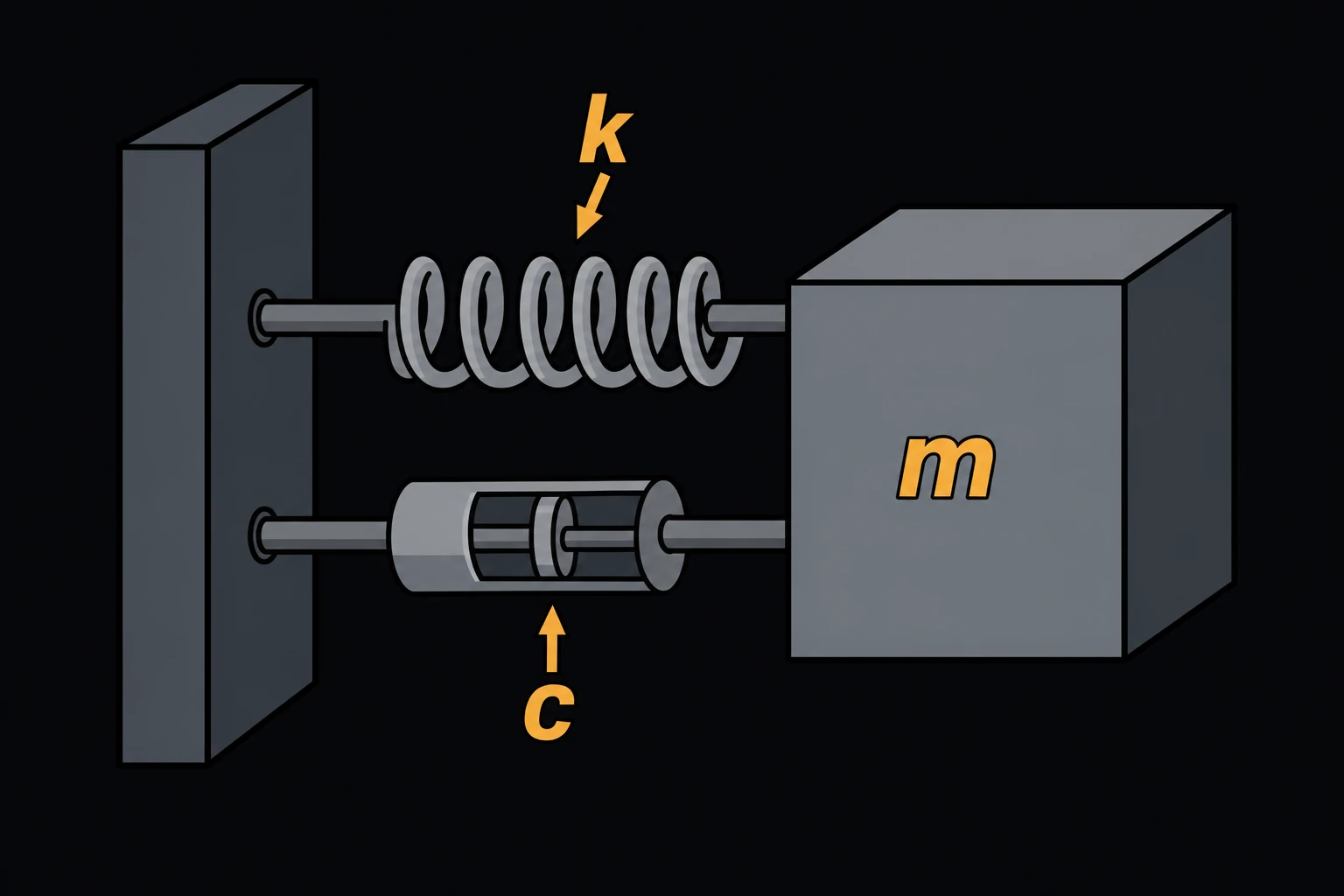
k is the spring stiffness, m the moving mass and c the viscous damping coefficient, the damper’s force per unit of velocity [1]. ωn is the undamped natural frequency and cc the critical damping, the least damping that stops the mass from swinging past its rest position. The damping ratio ζ compares the two. Below ζ = 1 the system is underdamped: it oscillates at the damped frequency ωd while the swings die away. At ζ = 1 it is critically damped, and above 1 it is overdamped; neither oscillates.
The live plot shows x(t)/x0, the displacement as a fraction of the starting one, for a mass released from rest. Drag the time cursor or type a time to read a point.
Limits and common mistakes
- The damping coefficient field is in N·s/m only. A damper rated 1.5 N·s/mm is 1,500 N·s/m.
- The model is linear viscous damping. Friction in joints and rubber hysteresis act differently, so a damping ratio measured from a decay test is often a better input than one built up from parts.
- Critical damping returns the mass to rest fastest without overshoot. More damping is not always better: an overdamped system creeps back slowly.
- Use the total stiffness and the mass that actually moves, as on the Natural Frequency calculator.
Worked example
A 120 kg pump sits on mounts with a total stiffness of 600 N/mm. The mounts’ data sheet gives a combined damping coefficient of 1,500 N·s/m. How heavily damped is the pump?
- Enter Spring Stiffness (k) 600 N/mm.
- Enter Mass (m) 120 kg.
- Enter Damping Coefficient (c) 1500 N·s/m and press Solve. The Solution shows:
Damping Ratio (ζ): 0.0883883
Critical Damping (cc): 16,970.6 N·s/m
Undamped Natural Frequency (ωn): 70.7107 rad/s
Damped Natural Frequency (ωd): 70.4339 rad/s
Condition: Underdamped — oscillates
Check: cc = 2√(600,000 × 120) = 16,971 N·s/m, and ζ = 1,500/16,971 = 0.088. With damping this light, ωd is within 0.4 % of ωn, so the pump rings for several cycles after a bump.